Constant Notifications at Work Are Robbing You of Productive Days
Constant notifications at work add up to whole lost days, because the work only you can do never gets the stretch of focus it needs.
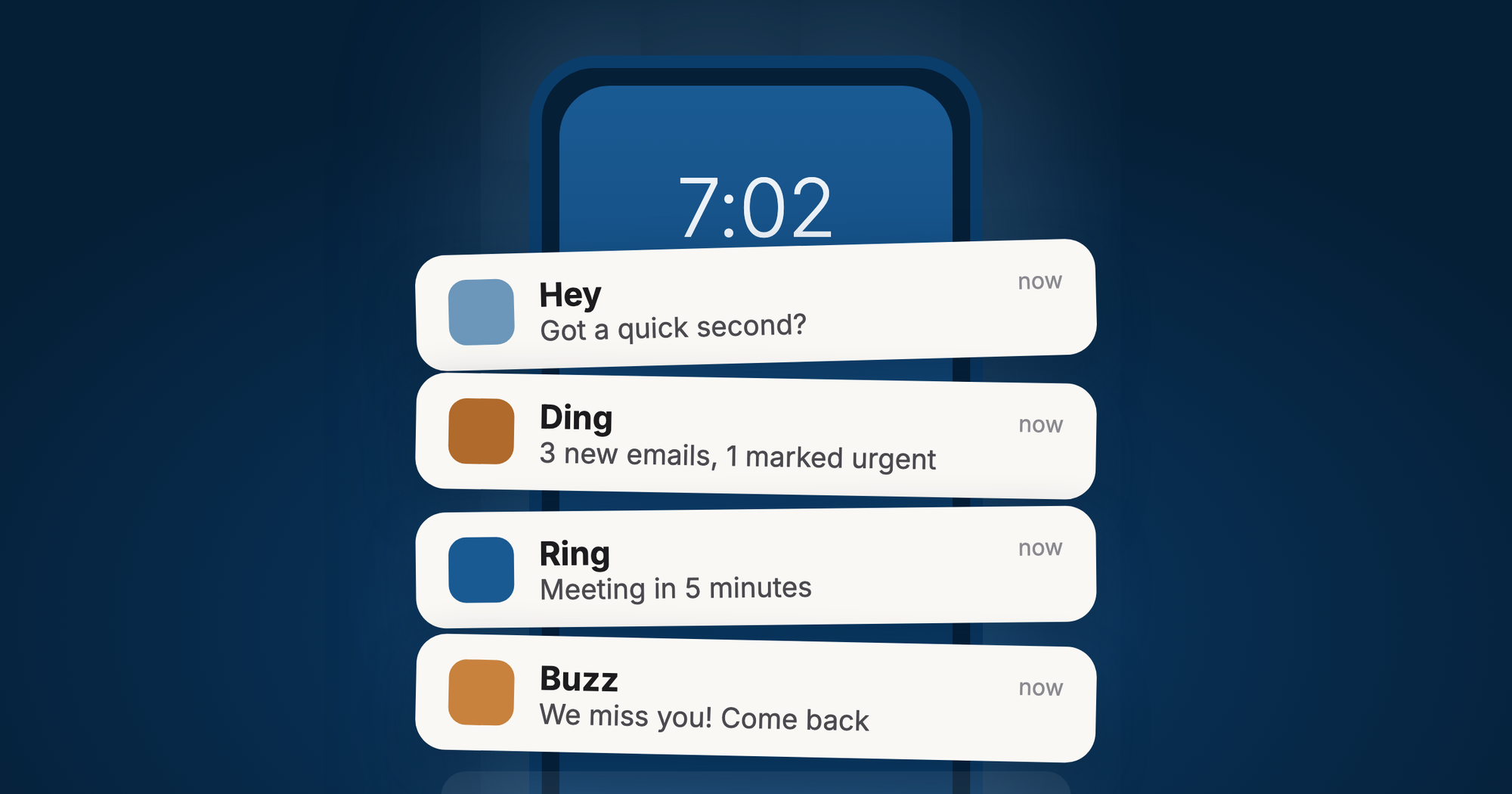

Hey, ring, ding... and another day is gone
Think back over the last month. How many days did the most important thing in your business actually move forward?
If the answer is fewer than you'd like, constant notifications and distractions at work are a big part of why. Each ping takes a few seconds. Together they take whole days, because the work only you can do never gets the focus it needs to start.
Here's how it goes. You wake up with a plan. Today is the day for the strategy work. Then your phone lights up.
Hey. A teammate on Slack needs a quick second. Ding. Three emails, one marked urgent. Ring. A reminder for a meeting you forgot you accepted.
By the time you sit down, the day has a new plan, and it isn't yours. You'll be busy until evening, and the strategy work will slide to tomorrow.
How much do constant notifications at work really cost?
Start with how often they come. Start with how often they come. Microsoft studied the busiest fifth of its Microsoft 365 users, ranked by pings received. During an eight-hour workday, a meeting, email, or chat reached them about every two minutes.
You don't have to be in that top fifth to feel it. The average worker in the same report got 117 emails a day and 153 Teams messages each weekday.
Now add how long it takes to recover. Gloria Mark, a UC Irvine professor who studies digital distraction, has found that it typically takes about 23 minutes to get back to your work after an interruption. Most people handle two other tasks along the way.
Put those numbers side by side. If the next ping comes in two minutes and getting back takes 23, you never get back. You spend the day starting.
That's how productive days disappear. Nothing big steals them. Hundreds of small pulls make sure the deep work never begins.
People feel it. In Microsoft's survey, 48% of employees and 52% of leaders said their work feels chaotic and fragmented.
Why does this hit founders so hard?
Your team can answer most Slack threads. Nobody else can set the strategy, make the key hire or decide on pricing. That work needs long stretches of thought, and it's the first thing to slide.
So a reactive day costs you more than it costs anyone else on the team. When your day goes, the company's most important work waits with it. String five of those together, and the business has lost a week.
Often the inbox sets the agenda before you do. Microsoft found that 40% of people online at 6 a.m. are reviewing email to work out the day's priorities. By 10 p.m., 29% of active workers are back in their inboxes.
The workday keeps getting longer, but you don't get more productive days out of it.
If you're a fractional executive, multiply all of this by every client's Slack.
How do you get your productive days back?
Start by counting. Look at your last 20 workdays and mark the ones where your most important work moved. That's your real productivity number, and it's worth tracking.
Then decide what's allowed to reach you:
- Choose what can interrupt you. A person who needs a decision from you, yes. An app reminding you it exists, no.
- Give the first block of your day to the work only you can do. Do it before the inbox writes your agenda.
- Check messages at set times. Most things marked urgent can wait an hour, and the rest will find you.
- Leave yourself a note when you get pulled away. Write down where you were, so getting back doesn't start from zero.
A lot of software is built to bring you back as often as it can. Until more tools are built to wait for you, protecting your days is up to you.
After every interruption you're left with the same question: what was I doing? That's one of the questions Deliberate is built to answer. It's a Mac app for Gmail and Outlook that also connects Slack, Asana, Granola meeting notes and Zoom, and it runs on your own Claude plan. It answers three questions. What was I doing? What do I need to do? What have I done?
Notifications won't stop coming. You can decide how many days they get to keep. If you run your own company, start counting this week.
- Microsoft WorkLab, "Breaking down the infinite workday" (Work Trend Index special report, June 17, 2025) Every two minutes in an eight-hour workday (top 20% of users by pings); 117 emails a day and 153 Teams messages per weekday (average worker); 48% of employees and 52% of leaders say work feels chaotic. Checked Nov 23, 2026.
- UC Irvine Informatics, citing Quartz (Gloria Mark quoted) 23 minutes 15 seconds to return to work after an interruption; two intervening tasks. Checked Nov 23, 2026.
- UC Irvine Informatics, citing Forbes Mark researches digital distraction at UC Irvine. Checked Nov 23, 2026.
Can we write to you now and then?
We write an occasional letter: what we shipped, what we got wrong, what we ruled out. No sequence, no schedule, unsubscribe is one click and we don't ask why.
Only ever used to send you the letter. Privacy